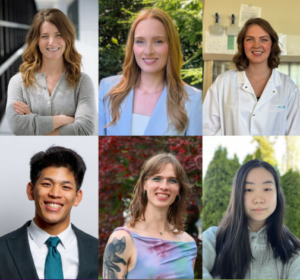
The Women’s Health Research Institute (WHRI) is very pleased to congratulate the recipients of the 2026 Graduate and Fellowship Research Awards in Women’s Health. This competition was supported thanks to the dedicated funding provided by the BC Women’s Health Foundation.
The WHRI launched this award in 2020 with a goal of creating a funding opportunity specific to our outstanding trainee community. This award provides salary support to WHRI-affiliated graduate students and postdoctoral fellows who are engaged in women’s and/or newborn health research under the mentorship of a WHRI member.
This year, the WHRI is funding six awards through this grant competition — two awards at the Master’s-level (valued at $30,000 each), two awards at the Doctoral-level (valued at $40,000 each) and two awards at the Postdoctoral Fellowship-level (valued at $65,000 each). In alignment with the WHRI’s 2025-2028 Strategic Plan and our goal to address foundational (basic science) knowledge gaps in women’s health, three of the six awards in this year’s competition (one at the master’s, doctoral and postdoctoral level), will support trainees in the basic/discovery/foundational sciences (i.e., biomedical, life sciences such as cell biology, genetics, biochemistry, physiology) whose project relates to women’s and/or newborn health.
Fellowship level Award Recipients
Basic Science

Recipient
Dr. Shay Waugh, Postdoctoral Fellow, Department of Microbiology and Immunology, University of British Columbia
Project Supervisor
Dr. Maria Tokuyama, Assistant Professor, Department of Microbiology & Immunology, University of British Columbia
Project Title
High-throughput screening and characterization of small molecule compounds that enhance vaginal mucosal barrier and antiviral immunity
Project Aims
Sexually transmitted viruses (STVs) are a significant global health threat due to their impact on sexual and reproductive health. STVs disproportionally impact cissexual women, transgender and transsexual (trans) women, trans men, and gender diverse individuals assigned female at birth. In individuals with a female reproductive tract, the vaginal mucosa is the primary site for STV entry and transmission between individuals. The vaginal mucosa is lined with epithelial cells which form a protective barrier and act as the first line of defence against STVs.
The proposed project aims to 1) identify novel host-directed therapeutic compounds that improve vaginal epithelial barrier integrity and enhance antiviral immunity and 2) investigate the impact of drug treatment on the establishment and maintenance of vaginal CD8+ tissue resident memory T cells (a type of white blood cell that remembers pathogen exposure, performs tissue surveillance, and activates immune responses that clear pathogens upon re-exposure). The findings of this project will advance the development of host-directed therapeutics that protect the vaginal mucosa against infectious agents and will enhance understanding of mechanisms underlying immune memory in the vaginal mucosa.
Non-Basic Science

Recipient
Dr. Alex Lukey, Postdoctoral Research Fellow, Department of Obstetrics & Gynaecology, University of British Columbia
Project Supervisor
Dr. Gillian Hanley, Associate Professor, Department of Obstetrics & Gynaecology, University of British Columbia
Project Title
How Many Can We Prevent? Modelling a Life Course Approach to Ovarian Cancer Risk Reduction
Project Aims
Ovarian cancer remains a devastating diagnosis, with two-thirds of patients succumbing to the disease within five years. All people with fallopian tubes and ovaries are at risk for ovarian cancer, including cisgender women, transgender men and non-binary persons. High-grade serous cancer (HGSC), the most common and deadly subtype of ovarian cancer, is primarily diagnosed at advanced stages, and most cases recur. Although the ovary is frequently the site of the dominant tumor mass, we now know that most HGSCs arise in the fallopian tube epithelium. There is no effective screening method for HGSC, making prevention the most powerful tool for reducing morbidity and mortality.
The objective of this project is to model the projected population-level reduction in ovarian cancer incidence and mortality achievable through a coordinated, life-course deployment of evidence-based risk-reduction strategies. This will enable prioritization of the interventions and implementation approaches most likely to produce meaningful population-level benefit.
Doctoral-level Award Recipients
Basic Science

Recipient
Megan Dyck, Graduate Student (PhD), Biochemistry, University of Victoria
Project Supervisor
Dr. Brad Nelson, Scientific Director, Immunotherapy Program, BC Cancer; Professor, Biochemistry and Microbiology, University of Victoria; Professor, Department of Medical Genetics, University of British Columbia
Project Title
Investigating the Complement Pathway as a Potential Immune Mechanism in High Grade Serous Ovarian Cancer
Project Aims
High-grade serous ovarian carcinoma (HGSC) is an aggressive cancer with limited treatment options. Nonetheless, the presence of tumour-infiltrating B lymphocytes (TIL-Bs) and other immune cells in HGSC is strongly associated with long-term survival, indicating the immune system can exert control over this disease. TIL-Bs produce antibodies that, in theory, could bind tumour antigens and trigger anti-tumour effects, including activation of complement. Complement is a group of proteolytic proteins in the blood that, upon activation, can directly mediate tumour cell death through a process known as complement-dependent cytotoxicity (CDC). Although theoretically compelling, the capacity of TIL-B to mediate complement activation and the role of this mechanism in promoting long-term survival remain unknown.
The objective of this project is to assess HGSC patient tumours and TIL-B antibodies for complement activation to elucidate the role of complement in the tumour microenvironment and in long-term survival. Findings from this project are poised to improve the field’s basic understanding of the immune system’s response to cancer and inspire novel immunotherapies, thus, improving outcomes for women with HGSC and related malignancies.
Non-Basic Science

Recipient
Andrea Stucchi, Graduate Student (PhD), School of Population and Public Health and Centre for Health Services and Policy Research, University of British Columbia
Project Supervisor
Dr. Laura Schummers, Assistant Professor, Faculty of Pharmaceutical Sciences, University of British Columbia
Project Title
The effect of Canada’s first universal contraception subsidy: a population-based interrupted time series analysis of pregnancy and abortion rates, hysterectomy volumes, and health system costs
Project Aims
Canada is the only high-income nation with a universal health care system that does not universally cover prescription medications, including contraception. While provincial health systems provide universal coverage for all pregnancy care (i.e., birth, abortion, miscarriage), they have not historically provided universal contraception coverage to enable pregnancy planning and prevention. In 2023, BC introduced Canada’s first universal, no-cost contraception program, making contraception free for provincially insured residents. Manitoba, Prince Edward Island, and the Yukon have since implemented similar policies. Early evidence from BC demonstrated that removing costs substantially increased contraception uptake, particularly for long-acting reversible contraception methods, while reducing out-of-pocket spending. However, the broader effects on downstream health outcomes and health system costs remain unknown.
The objective of this project is to perform a rigorous evaluation of BC’s contraception subsidy on pregnancy and abortion rates, hysterectomy volumes, and health system costs using population-level data. This project will provide the first Canadian evidence on the clinical and economic impact of universal contraception coverage, generating timely evidence to inform equitable reproductive healthcare nationwide.
Master's-level Award Recipients
Basic Science

Recipient
Seraphina Lu, Graduate Student (MSc), Biochemistry and Microbiology, University of Victoria
Project Supervisor
Dr. Caroline Cameron, Professor, Biochemistry and Microbiology, University of Victoria
Project Title
A multi-omics investigation into the host response of human macrophages to Treponema pallidum, causative agent of syphilis
Project Aims
Syphilis is a sexually and vertically transmitted infection and rates in Canada have increased over the past decade. Syphilis is a re-emerging worldwide public health issue, with 7.1 million individuals newly infected in 2020, and congenital syphilis (caused by transmission during pregnancy) continues to be the leading infectious cause of preventable stillbirths. Syphilis is a multistage disease caused by the bacterium Treponema pallidum subspecies pallidum (Tp). Tp can cross the placental barrier, infecting the fetus during pregnancy, and this can lead to stillbirth, prematurity or clinical symptoms in infants. Despite rising syphilis rates, the mechanisms of pathogenesis employed by Tp remain incompletely understood. Identifying how Tp causes disease and how the host responds is critical to addressing knowledge gaps in the field.
This project aims to use multi-omics to characterize the response of human macrophages to Treponema pallidum exposure. Identifying pathways involved in protection against the pathogen and dysregulated pathways manipulated by the pathogen will inform syphilis vaccine design.
Non-Basic Science

Recipient
Jeremiah Tan, Graduate Student (MSc), Faculty of Pharmaceutical Sciences, University of British Columbia
Project Supervisor
Dr. Mary De Vera, Associate Professor, Faculty of Pharmaceutical Sciences, University of British Columbia
Project Title
Hydroxychloroquine adherence in the perinatal period in autoimmune rheumatic disease: Patterns and predictors
Project Aims
Autoimmune rheumatic diseases (ARDs) such as rheumatoid arthritis, systemic lupus erythematosus, and spondyloarthropathies heavily impact women and present challenges to reproduction. Left uncontrolled, pregnancies in patients living with ARDs are associated with adverse outcomes to the mother (e.g., pre-eclampsia, gestational diabetes, renal complications) and the baby (e.g., premature delivery, fetal growth restriction). The need for careful disease management on pregnancy-compatible medications to minimize maternal and neonatal risk is well-documented. Hydroxychloroquine (HCQ) is an antimalarial that has become a well-established frontline drug in the treatment of ARDs. In pregnancy, HCQ has been recognized for its role in optimizing maternal and fetal outcomes. Despite its widespread use, the rate of HCQ discontinuation in pregnancy remains as high as 87% by the third trimester. Among patients who continue HCQ throughout pregnancy, the degree to which the medication is taken as prescribed remains poorly characterized.
This project aims to better understand patterns of HCQ adherence during the perinatal period among women with autoimmune rheumatic diseases and to identify factors associated with adherence. Improved understanding of the factors associated with HCQ adherence and implementation may help identify modifiable targets for intervention and ultimately reduce the risk of adverse maternal and fetal outcomes.