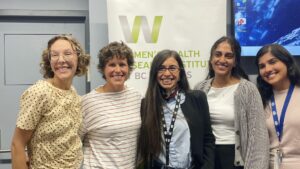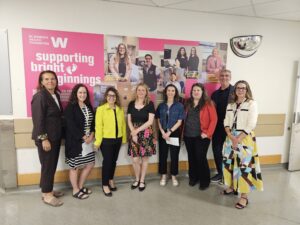
Congratulations to the WHRI Spring 2026 Trainee Travel Grant Recipients
Congratulations to the winners of the Spring 2026 trainee travel grant competition.

Congratulations to the winners of the Spring 2026 trainee travel grant competition.

Congratulations to WHRI member Dr. Cheryl Wellington, who recently received a Brain Canada 2025 Platform Support Grant to facilitate her leadership of the UBC Core Facility for Neurology Biomarker Innovation (CFNBI).

The WHRI is collaborating with the Clinical Research Support Unit at BC Children’s Hospital Research Institute to evaluate a process that combines AI translation with structured human review for research documents – and you can help.

This May, the Women’s Health Research Institute (WHRI) formalized our commitment to Trauma and Resiliency-informed Practices (TRiP) with a new offering: TRiP Training for Researchers and Evaluators. This work was facilitated by long-time WHRI partner BC Pomeroy and WHRI Qualitative Research Analyst Julia Santana Parrilla.

The 11th annual Women’s Health Research Symposium highlighted two decades of progress in women’s health research and served as an excellent kickoff to Women’s Health Research Month.

WHRI’s Qualitative Research Analyst, Julia Santana Parrilla, and Heather McCain—member of the Beyond the Binary Community Task Force and Founder & Executive Director of Live Educate Transform Society (LET’S)—were recently featured on Leader Talks, where they reflect on their work with BTB and the importance of centering diverse gender experiences in research.
The Women’s Health Research Institute would like to acknowledge that we are uninvited guests on the unceded ancestral territories of the xʷməθkwəy̓əm (Musqueam), Skwxwú7mesh (Squamish), Stó:lo, and sel̓íl̓witulh (Tsleil-waututh) Nations.
As a provincial research institute committed to improving the health outcomes of women, including those across the 2SLGBTQIA+ spectrum, we recognize our responsibility in the collective effort towards establishing culturally safe health care systems and services that address health inequities among Indigenous peoples, especially Indigenous women, girls, and Two-spirit peoples.
We encourage all people involved in research to read both the Truth and Reconciliation Commission of Canada: Calls to Action and the In Plain Sight Report, and reflect on ways we can incorporate the recommendations into our work. As we gather in spaces together, we encourage you to reflect on your positionality on these lands and your personal commitments to reconciliation.