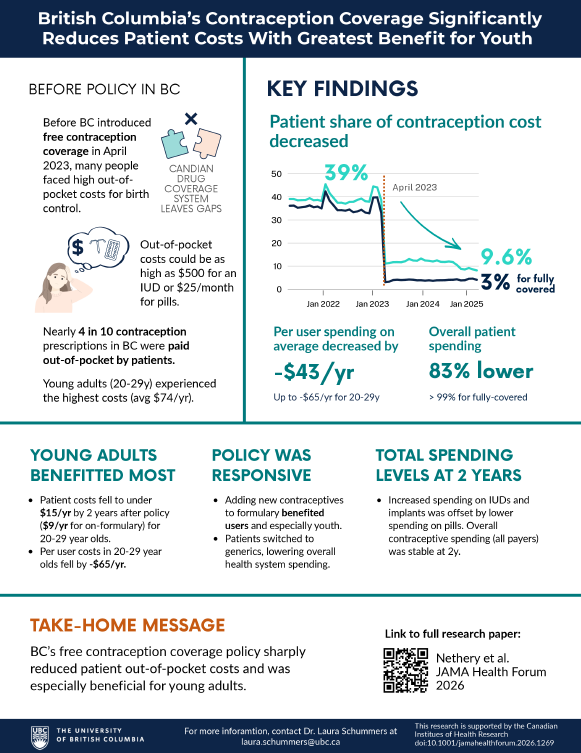
A paper authored by a team of UBC researchers, led by WHRI members Dr. Elizabeth Nethery and Dr. Laura Schummers, was published today in the journal JAMA Health Forum. The paper, titled Universal Free Contraception Coverage Policy, Out-Of-Pocket Payments, and Costs is the first to quantify the economic impacts of the Government of British Columbia’s implementation of universal coverage for contraceptives in the province beginning in April 2023.
Estimates are that roughly 40 percent of pregnancies in Canada are unintended. Unplanned pregnancy disproportionately impacts lower income people, who often face greater barriers to accessing reproductive health services, including contraception and abortion, partly due to cost. The province’s move to universal coverage for contraception led to a 49% increase in contraceptive uptake across the province, as well as increasing the proportion of individuals who chose Long-Acting Reversible Contraceptives (LARCs) – as shown in an article published by Dr. Schummers and team in the BMJ in July 2025.
Key findings
- BC’s universal free contraception policy cut patient out-of-pocket costs by 83% within two years – with the biggest gains for young adults – and total contraceptive spending across all payers was no higher in BC than in other provinces at two years.
- Canada’s mixed insurance system leaves contraception particularly exposed. The share of out-of-pocket contraception costs was much higher than for many other medications. Younger adults – the most likely contraception users – may not yet have workplace drug coverage. And some people choose to pay directly for privacy reasons rather than use a family or partner plan.
- Young adults were paying the most for contraception before universal coverage and saw the biggest drop in costs. In Canada’s patchwork drug insurance system, young adults fall through the cracks more than anyone. Too old for a parent’s plan, too new to a job with benefits, they were paying out of pocket for contraception at higher rates than any other age group – nearly half of all their prescriptions, at an average of $74 a year, with up to $500 upfront for an IUD. Then British Columbia made contraception free. Within two years, costs for young adults had fallen to under $15 a year.
According to Dr. Schummers, “[r]emoving cost barriers increased uptake of the most effective methods, which helps reduce unintended pregnancy and inequality—adding to strong evidence that universal contraception coverage is essential in Canada.”
This publication supports the benefits of universal coverage for contraceptives, and shows how removing access barriers, such as cost, enables individuals to make the healthcare decisions that are right for them.
Download the facts sheet