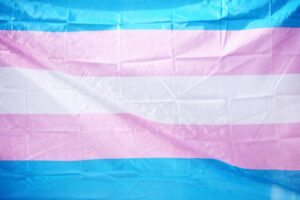
Featured image: the transgender flag, with blue, pink, and white stripes.
November 13 to 19 is Transgender Awareness Week. This annual week offers us space to honour and celebrate the transgender, non-binary, and gender diverse people in our lives and communities. It is also an opportunity to highlight opportunities for researchers and health professionals to improve their knowledge of the unique issues faced by trans and gender-diverse individuals and build systems that provide better support for these communities.
Transgender Awareness Week is capped off every year with Transgender Day of Remembrance on November 20, which honours the trans and gender-diverse people lost to ongoing anti-trans hate and violence.
In observance of transgender awareness week, we spoke with Heather McCain (they/them), founder of Live Educate Transform Society (LET’S) and community partner in the development of the Beyond the Binary Guide.
What is LETS?
Heather started LET’S in 2005 after years of frustration at the lack of accessible spaces and services that they observed in their community. Heather notes that they had frequent difficulty with public transit operators refusing to put down the wheelchair ramp so they could get on to a bus, severely impacting Heather’s ability to travel locally.
After conversations with other community members revealed similar experiences for people with various disabilities, Heather founded LET’S – and noted that they had much more success sparking change as a representative of an organization, as opposed to an individual.
Today, LET’S is an organization run by and for disabled and neurodivergent people. Many of the staff and volunteers at LET’S are 2SLGBTQIA+ as well as disabled and/or neurodivergent. As an organization, LET’S provides its staff with a platform to utilize their own lived experiences and intersectional identities to advocate for accessibility in their communities. In addition, LET’S designs and delivers educational workshops for organizations across all industries, teaching leaders and policymakers how to show up for disabled, neurodivergent, and queer folks.
One of LET’S key services is accessibility tours, giving businesses immediate, actionable feedback on how to make physical spaces more accessible for disabled and neurodivergent people. The organization also offers low-sensory space setups for organizations and events throughout BC’s lower mainland, such as the Vancouver Pride Society.
What does this work have to do with trans awareness?
There is significant overlap between the 2SLGBTQIA+ and neurodivergent communities. Some research suggests that people with certain neurological differences, such as autism and Obsessive Compulsive Disorder (OCD), are more likely to be transgender or gender diverse than neurotypical people. We don’t know exactly why this is, but there is some speculation that the experience of being neurodivergent and being told that you don’t fit into societal norms in one way can encourage people to question what other ways they don’t “fit in”. People who have already found community outside the “norm” may be more comfortable exploring and questioning other norms, like gender.
Building spaces that are more equitable for neurodivergent and disabled people can open the conversation and encourage organizations to think about other experiences outside of neuro-centred, non-disabled, cisgender norms – and in turn, make changes to better support people with those lived experiences.
Beyond the Binary
In addition to their work with LET’S, Heather has contributed as a community partner to the Women’s Health Research Institute (WHRI)’s Beyond the Binary guide. The guide is a resource for researchers, clinicians, community partners, and others working in the health and academic spaces.
Heathers’ work with WHRI and the BTB guide began about 6 years ago, at the start of the initiative to develop the guide. In the years since, Heather has provided advocacy for the guide from the perspective of a patient and community member, as well as creating supplemental video content for medical students aimed at increasing knowledge of intersectionality in healthcare.
One of Heather’s primary goals in providing education to medical students is to get future doctors thinking about things they may encounter in the real world that aren’t necessarily talked about in the classroom or in textbooks. With formal medical education still lacking in the areas of 2SLGBTQIA+ and neurodivergent patient care, stories from people with lived experience can help fill in the gaps and encourage future clinicians to see transgender, disabled, and neurodivergent folks as people who deserve quality healthcare, rather than just case studies.
Heather stresses that their workshops are designed to meet people where they are in their learning journey. As discussed in the Beyond the Binary Guide, language around equity-deserving groups is constantly shifting, and can be difficult to keep track of even for those within these communities. For English learners and newcomers, or folks who just don’t have much knowledge or firsthand experience with 2SLGBTQIA+ and neurodivergent populations, prescriptive language conventions can be intimidating. Many people hear conflicting messages about which words to use, or black-and-white statements about which words are offensive, and these messages can be barriers for those who might be open to learning.
Heather acknowledges this anxiety, and stresses that making mistakes is okay. It’s important to recognize the nuance between intentional misuse of language, and an unintentional slip by someone who is learning and may be unaware of the connotations of certain terms. Being willing to learn and show up for equity-deserving populations is more important than getting the words exactly right. Accessibility is a two-way street, and if we want organizations and people to learn to support trans, neurodivergent, and disabled folks, then we need to afford them the same accessibility and support in return.
How does building awareness improve accessibility?
Helping organizations become more accessible in their physical spaces and culture doesn’t just benefit trans and neurodivergent populations. Accessibility benefits everyone. One area that we see this in is in hiring practices; women and gender minorities often avoid applying for jobs unless they meet every qualification listen in the job description, which contributes to the underrepresentation of women, trans, and neurodivergent people in workplaces, which in turn limits opportunities for advocacy and accessibility improvements. Advocating for simpler job descriptions and better distinction between requirements and “nice-to-haves” is an accessibility measure that can have an outward ripple effect for many different groups of people.
2SLGBTQIA+ people, neurodivergent people, and disabled people are fighting different battles, yet these battles overlap significantly. Uplifting one equity-deserving group can help to uplift others. This transgender awareness week it’s important to consider how we make language and spaces accessible to all.