All images courtesy of UBC Faculty of Medicine.
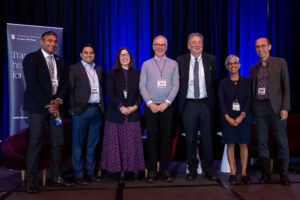
On April 8th and 9th, the University of British Columbia (UBC) Faculty of Medicine held their second annual Transforming Health Symposium. This year, the symposium was themed around biomedical innovations, healthcare system transformation and innovation through research, with a half–day event centered around advances in Artificial Intelligence. WHRI staff members Nicole Prestley and Haley Foladare attended the symposium along with health authority staff and clinicians, representatives from private sector biotechnology and healthcare AI companies, not–for–profit organizations such as Genome BC, clinician scientists from UBC and the University of Toronto, and various members of the research community, including WHRI-affiliated researchers. The event provided ample opportunity for researchers and staff to connect and discuss the current advantages and inhibitors of health transformation across British Columbia.
This symposium comes at a pivotal time for the BC life sciences, coinciding with the release of the third edition of the Life Sciences in BC Sector Profile. This report highlights the growth of the Life Science sector in BC since the COVID pandemic, emphasizing the strong collaborations between academic institutes and biotech companies that have contributed to steady growth for the sector. Hospital based research institutes, such as WHRI, are recognized in the report as a key academic institution enabling innovative and transformative research in BC. Three key themes emerged from the event.
1. Building a clinical trials ecosystem
Panelists and speakers spoke to the importance of equipping hospitals and health centres to operationalize clinical trials, and of identifying practitioners to be site champions within their respective centres. The vision is a province where drugs and interventions are developed and tested in BC first.
2. Equity in AI and innovation
Speakers cautioned against a purely capitalist approach to innovation, citing examples of how the pursuit of profitability at all costs has often left rural and remote communities in BC behind. Continued advocacy for bringing more resources and research to rural areas will lead to more effective solutions for a broader range of communities. Trust in both innovation – and the process of innovation – is another factor, alongside recognition of the role that trust-based patient-provider relationships play in research and system transformation. While there was a call to action for health systems and researchers to draw their attention to AI to inform “best case” applications, there was recognition that AI in a health context cannot be implemented without human oversight.

3. Combatting misinformation
WHRI member Dr. Meaghan Thumath of the Health Equity and Resilience Observatory (HERO) Lab at UBC presented strategies to fight misinformation at scale, demonstrating novel frameworks and tools designed to identify and mitigate the flow of healthcare misinformation through communities. Talks throughout the symposium emphasized the increased need for system resiliency due to the current political and cultural environment. Meaghan and other speakers suggested that resiliency happens at system levels, necessitating increased interdisciplinary and cross-sector collaboration. She invited researchers, non-profit organizations, and government agencies to invest resources into facilitating these larger scale collaborations, and balance complexity with scale.
For further reading, we encourage you to check out the resources shared at the symposium, below:
Organizations
UBC AI and Health Network
UBC research network focused on the use of AI to drive healthcare system transformation and improved patient care.
UBC Data Science and Health
UBC research cluster aiming to facilitate usage of health data to promote healthcare advancements in BC.
HERO Lab
UBC lab lead by Dr. Meaghan Thumath aiming to reduce the spread of disinformation and promote equitable health information systems.
Bridge Research Consortium
Research consortium focused on vaccines and immunity-based innovations.
BC Children’s Hospital Research Institute AI Data Science Unit
BCCHR Unit providing AI and data science services for healthcare researchers.
Tools and Resources
Gemini VITAL
Health data platform to connect hospitals and enable Electronic Health Record (EHR) data for research.
Edelman Trust Barometer
Annual report outlining the state of global public trust in government, business, science, and NGOs.
Genome BC Indigenous People’s Engagement Framework
Framework outlining how Genome BC interfaces with Indigenous Peoples, providing a model for Indigenous-led engagement and innovation.